http://www.facebook.com/?ref=home#!/video/video.php?v=180999631925246
A few weeks ago, my friends and I got together for a "just dance 2" party. In this video, Zach and Evan are dancing to "Its Raining Men"; while the dance itself was really funny, it was even funnier when people started "zapping" each other. While we were dancing, we became charged by friction. The carpet rubbing against Zach's socks made him extra charged, and showed how rubbing two materials together causes the transfer of charge from one object to another. When two materials rub against each other, one will want to hold on to its electrons, while the other will let go of its electrons.
Sunday, January 30, 2011

Sunday, January 9, 2011
ANGULAR MOMENTUM: blog 8 :)
http://www.youtube.com/watch?v=2gYEtBwmiPE
Physics affects many aspects of dance, including one of the hardest parts- turns. There are many types of turns: pirouettes, coupe turns, fouette turns, pencil turns, etc. etc. The speeds at which a dancer turns for each type differs- fouette turns are much slower than coupe turns. This is because Angular momentum is equal to moment of inertia times angular velocity, and because angular momentum is conserved. In a fouette turn, a straight leg is extended parallel to the ground. This increases the radius of the dancer, which causes the dancer's moment of inertia to increase, due to the fact that moment of inertia is equal to mass times radius squared. When moment of inertia is larger, then the angular velocity is less. In a pirouette, however, the radius is smaller because the leg is bent so that the foot is at the knee, which means moment of inertia is smaller. The angular velocity of a dancer doing a pirouette is larger than if the dancer were doing fouette turns, which is why pirouettes are faster than fouette turns.
This is a video from Winter Showcase two years ago, and it includes alesicon turns (which are like fouette turns because the leg is fully extended) and goes straight into pirouettes. The change in speed is a little hard to see, but when you are doing the turns, the change in velocity is very noticable.
Physics affects many aspects of dance, including one of the hardest parts- turns. There are many types of turns: pirouettes, coupe turns, fouette turns, pencil turns, etc. etc. The speeds at which a dancer turns for each type differs- fouette turns are much slower than coupe turns. This is because Angular momentum is equal to moment of inertia times angular velocity, and because angular momentum is conserved. In a fouette turn, a straight leg is extended parallel to the ground. This increases the radius of the dancer, which causes the dancer's moment of inertia to increase, due to the fact that moment of inertia is equal to mass times radius squared. When moment of inertia is larger, then the angular velocity is less. In a pirouette, however, the radius is smaller because the leg is bent so that the foot is at the knee, which means moment of inertia is smaller. The angular velocity of a dancer doing a pirouette is larger than if the dancer were doing fouette turns, which is why pirouettes are faster than fouette turns.
This is a video from Winter Showcase two years ago, and it includes alesicon turns (which are like fouette turns because the leg is fully extended) and goes straight into pirouettes. The change in speed is a little hard to see, but when you are doing the turns, the change in velocity is very noticable.
Saturday, January 1, 2011


Saturday, December 11, 2010
V= r (omega): blog 7 :)


Linear speed depends on radial distance from the center and rotational speed.
If we are making a left turn, then the dancers on the left side must travel very little, and almost stay in place as we round the turn. The dancers on the right, however, must make long strides while maintaining our straight lines. While both sides have the same rotational speed, the radial speeds are different because the dancers on the right are traveling at a faster speed, with a larger radius.
Wednesday, November 24, 2010
iMPULSE: blog 6 :)
At the last dance team pool party, the whole team was putting their dancing skills to use when they jumped into the water. Instead of the traditional cannonball, there were countless straddles, aerials, and flips- we drove the lifeguards crazy... :)


Looking back, I realize that not only was that an afternoon of fun, but an afternoon of physics as well. Since the water slows us down as we deccelerate to a final velocity of 0 m/s, the amount of time it takes is greater than it would be if we were jumping onto a hard surface.
Impulse= force times time
Since the water allows us to come to a stop slowly, the amount of force we feel as we hit the water is minimal. If we were to jump onto a hard surface, then the time it takes to come to rest is much smaller. Since force and time are inversely related, the amount of force we feel when we jump onto a hard surface is much greater. Good thing we dont feel very much force when we jump into water, or some of these jumps would have hurt.


Looking back, I realize that not only was that an afternoon of fun, but an afternoon of physics as well. Since the water slows us down as we deccelerate to a final velocity of 0 m/s, the amount of time it takes is greater than it would be if we were jumping onto a hard surface.
Impulse= force times time
Since the water allows us to come to a stop slowly, the amount of force we feel as we hit the water is minimal. If we were to jump onto a hard surface, then the time it takes to come to rest is much smaller. Since force and time are inversely related, the amount of force we feel when we jump onto a hard surface is much greater. Good thing we dont feel very much force when we jump into water, or some of these jumps would have hurt.
Sunday, November 7, 2010
POWER: blog 5 :)
My friends and I have a special tradition where if one of us has a birthday coming up, the rest of the group plans a day of surprises for them. My friend Chelsea's birthday was during the beginning of july, and was the last of our group's sweet 16s. After secretly coordinating the day with her parents, we successfully blindfolded her and led her into the car for the start of our day of surprises :) After the hour long road trip, we finally made it to our destination- WET N WiLD :)

We spent the whole day floating in hurricane bay, sliding down the shaka, and tanning under the sun. What I didn't realize at the time, was that physics was responsible for a lot of the fun we had racing down the waterslides.
Power (Watts) = Work (Joules) over Time (Seconds)
Work is equivalent to net force times displacement, and in this scenario, the net force was equal to the force of the current of the water pushing us down the slides, minus the friction of the floaties against the water and the bottom of the slide. Displacement was equal to the length of the silde (in meters) and the time was the amount of time taken from the beginning to the end of the slide. Because the force of the current was high, the friction was low, the length of the slide was long, and the time it took to reach the bottom was short, the power of the system was HUGE. And we definately felt it on some of these rides...


Power (Watts) = Work (Joules) over Time (Seconds)
Work is equivalent to net force times displacement, and in this scenario, the net force was equal to the force of the current of the water pushing us down the slides, minus the friction of the floaties against the water and the bottom of the slide. Displacement was equal to the length of the silde (in meters) and the time was the amount of time taken from the beginning to the end of the slide. Because the force of the current was high, the friction was low, the length of the slide was long, and the time it took to reach the bottom was short, the power of the system was HUGE. And we definately felt it on some of these rides...


Overall, it was a REALLY fun day :)
Sunday, October 17, 2010
iNCLiNED PLANES AND FRiCTiON: blog 4 :)
This past summer, my friends and I decided to make a summer to do list, filled with all sorts of fun summer activities such as a trip to the waterpark and riding a catemeran. The most adventurous thing on our list was probably hiking, since none of us had really ever hiked anything more rigorous than Diamond Head. We had heard of a beautiful hidden area called "Maunawili Falls", and decided THAT was where we were going to hike.

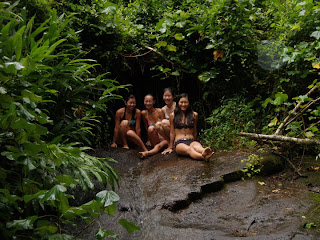


After what seemed like forever, WE MADE IT TO THE WATERFALL :) but my friend Daniel urged us too keep climbing, up OVER the waterfall to a hidden surprise. Reluctantly we ventured over huge pipes, across bridges, and up rocky walls until we finally found it- the moss slides.

Water from another waterfall splashed down huge rocks covered in moss, the perfect area to slide down. As we climbed up, the rocks began to make a sharper incline with the ground, and the acceleration of an object going down an inclined plane is greater than the acceleration of that same object on level ground. The farther down we slid, the faster we accelerated. iT WAS SO MUCH FUN. What also made this area perfect for sliding was the moss covering the rocks. Friction is a force the opposes the motion of an object in contact with another object moving past it. Friction depends on the two materials in contact, which in this case would be the moss and our skin. Moss is very soft, and we had a hard time climbing up the rocks because there was so little friction.This means that the coefficient of friction, in this scenario the friction between the moss and our skin, was very little.
Friction= the coefficient of friction multiplied by the normal force
Because the coefficient of friction was so small, the overall friction was small, and therefore made it easy for us to slip. Although I'm not much of a hiker, I really did enjoy the moss slides. :)

Subscribe to:
Posts (Atom)